Hi fellow Guzzi enthusiasts. I’m new to the club, Moto Guzzi bikes, and doing my own maintenance. I have a 2023 V85TT and on its MOT it had an advisory on the rear brake. Following various articles, blogs and UTube videos I took the calliper off swapped around the pads, cleaned with a toothbrush/brake cleaner and it seems to work ok back on the road. But as the pistons operate from one side and the brake sits reasonably snug around the disc, how can I tell whether it’s re-centering correctly. It’s not stuck but when spinning the wheel when the bike’s on the centre stand it’s not entirely unrestricted either. That’s a long way of saying what part of the calliper/brake provides the self centering, and how should I maintain it?
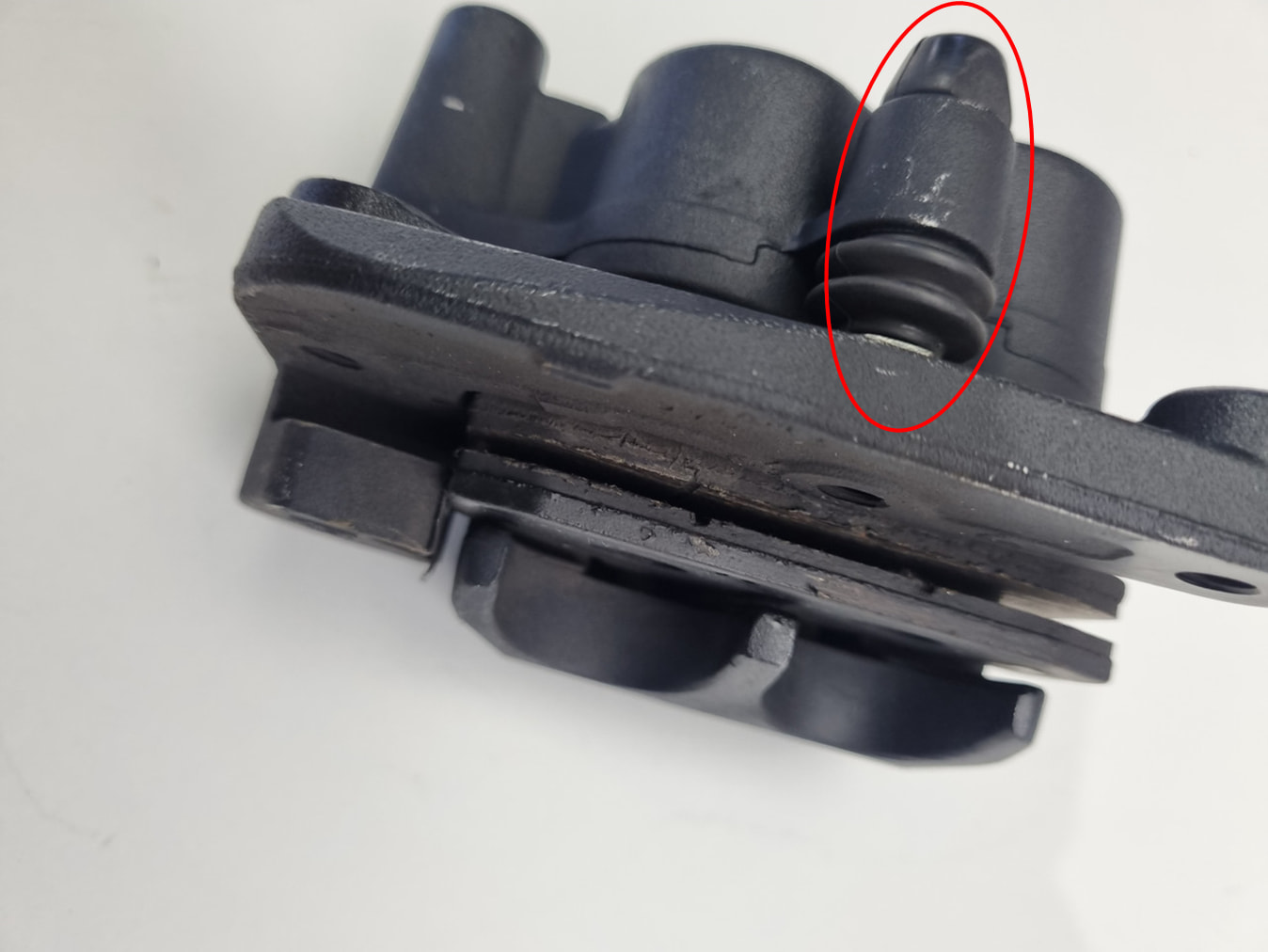
A possibly related question- what is the role of the highlighted pin/screw on the caliper below.
Any guidance or support you can provide would be much appreciated!
The calliper has two sliding pins with rubber grommets to keep the muck out. Pull the calliper apart clean and grease with red rubber grease. Both halves of the calliper must slide easily. The pads must slide on the pad pins as well.
Just a slight addendum.. brake calipers self centre as long as the pistons move freely and normally and the slide pin is clean and smooth. Noticing that one pad more worn than the other and not sure if they are a matched pair?? That could be why they are not worn equally though some caliper setups just tend to do that. If you have cleaned every floating part and light lubed that’s about as much as you can do. The other variable is as is common with many rear brakes there is only pistons on one side. i.e. that ‘back plate’ is passive and again can result in one side wearing more than the other. Just the way it is. Hope that helps.
Thanks both - where do I locate the sliding pins with grommets- those presumably aren’t the pins that hold the pads in place (accessible from the right side of the bike)?
I took the bike out for a run and consciously kept off the rear brake- the disk was cool to the touch at the end of the run (not very scientific but made me feel better )
Sorry, I’m being a muppet - by pins you mean the two piston type ‘pins’ that push the pads onto the disc.
As an aside when I physically pushed against the calliper in situ, it created play after 2-3 pushes between the pins and the disk which pumping the brake then took away. At the same time that small pin with the rubber sheath (that I posted a picture of), also moved in and out of its rubber sheath.
Hi. They are really only retaining pins to stop your pads riding up or out but you don’t want them grungy or crusty as the top of the pads need to be able to move inrelation to them.
Releasing lever pressure is enough to let the pads ‘relax’ away from the disc thus normally not producing friction or heat. The gap is almost invisible.
As for replacement found this on fleabay but no gaitor?
What the others have said - this kind of sliding caliper seems to be common on mototcycles in recent years - the new V7’s have got this type of caliper at the rear - the sliding pins are what you have circled in red …
At the earliest opportunity have the caliper off and the sliding pins all apart, and cleaned and regreased.
Also, if the pad retaininig pins look like Allen key grub screws, have these out sooner than ASAP and grease with copper slip on replacement. Do this even on a brand new bike because if they seize up you are in a whole world of aggro.
HTH
Appendix (edit) - also smear some silicone grease around the hydraulic pistons too, to keep the muck out as best you can and stop them corroding and seizing up. Again do this ASAP on a brand new bike.
These are the pad retaining pins, not the caliper sliding pins.
Red rubber grease is better than no grease at all but will start to melt and run if you get the brake really hot (100C +). The best stuff is the specifically designed Molykote G-3407 - stable to over 200C. But it comes in 18kg pails which will last you until the heat death of the universe. Occasionally an enterprising chap will sell small amounts on Ebay.
Less is better when attempting to grease pistons or pad retaining pins. A Q-tip with a little on will be enough. Brake pads and grease don’t work well together.
When the brake is applied then released the seals pull the pistons back (a very small amount) if the pistons are clean and the seals are good they wil pull back evenly leaving the caliper centred.
On a sliding-caliper brake like this as the pads wear the caliper will slide across slightly to compensate, if the pins are not clean and greased the caliper sticks in place and the pad pushed by the piston will wear more than the pad held in the caliper.
All greased and reassembled. The wheel definitely turns further when I spin by hand. I think that copper grease will be my new best friend. It was so easy to hand tighten the bolts and when I did the last part of the turn with the socket I got back to the manufacturer’s mark which hadn’t been the case when it came back from its last service. Very impressive.
 )
)

 (Seriously there are YouTube videos of people doing this
  )
) .
.
 Happy roads ahead!