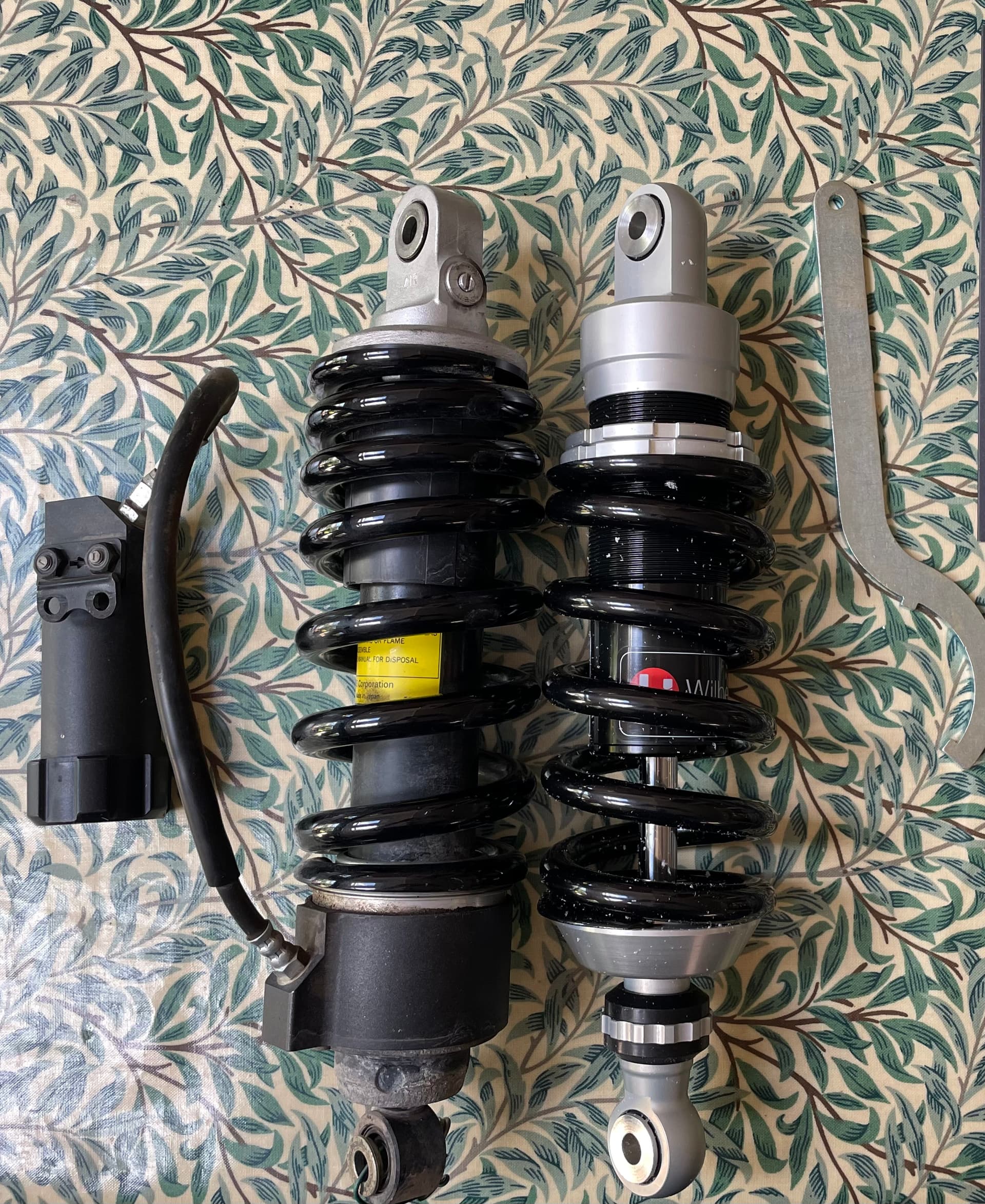
Ok, it’s so hard to be objective with motorcycle suspension! What appeared a great improvement for the Stelvio at first after getting professional advice on the settings still left me wanting better. So as the bike passed 13,000 miles I bought a new rear shock from a one-man suspension specialist in the East of England.
It was built to order for a 95kg rider and is not the top of the range for this manufacturer, not having a remote reservoir nor multiple damping settings. It’s the same length as the original and gives the same static and dynamic sag measurements. No remote preload adjustment either…
This shock from Wilbers is what the Stelvio should have had from OEM. Key difference is the way it handles sharp bumps calmly. No longer do I wince going over motorway seams or sunken drains in poorly maintained city roads. Bumpy road cornering at speed tracks perfectly and comfortably.
Another change I made was from Michelin Anakee to Road 6’s. Much quieter and grip better. In a previous thread I complained about a weird resonating whine from the rear wheel, worst at 63mph. That’s not there with the Road 6, so another small win 
4 Likes
As it is a good result, I believe you can mention who the maker is…
different if you were slating them
It would be a secret if it wasn’t for the ‘from Wilbers’ 
Bought from MCT Suspension.
Can’t believe I missed that- has been a long day
1 Like
Hi, been reading with interest your post re suspension settings/findings and replacement shocks. Also varying others subjective findings about suspension.
A common thread I am finding is that despite finding acceptable settings for preload/rebound several say the suspension still feels on the harsh/stiff side on poor surfaces/drain holes etc.
I am a new owner of a V100 Mandello, standard version ‘23 with only 3500 miles on and been pursuing the optimum settings for me at 76kg rider only. Original Pirelli Angel GT’s with moderate wear. Still fine tuning but close.
One factor I have seen no one address is tyre pressures? In my fiddling I questioned the factory reccomendations of 40.6psi rear and 36psi front. In short, I took 3psi out of both ends 37/33 and immediately felt improvement in some reduced harshness and better front wheel feedback.
I have to admit I am not a great fan of the Pirellis and for years now have been a convinced Michelin Road series in all respects, grip,longevity, feel etc. and will be replacing with Road 6’s when needed. I really do not like particularly the front feel of the Pirellis and in the past similar disquiet with Bridgestone 23’s.
Just a small observation on my part and accept that there is an almost infinite spectrum of riders, tyres, settings and personal preferences for a plush vs sporty feel.
Thus far I am,for me, finding increased confidence in handling as I progress as I know the bike is superbly willing to scratch a bit when in the mood.
On a previous big sport tourer I had for 10yrs I replaced the original Kayaba with a basic Ohlins unit and was impressed. In future may go that road again with Ohlins or maybe a Hagon unit or similar.
Happy riding! Dave
2 Likes
I agree on the superiority of Michelin Roads (5 or 6) over the Pirelli Angel GT. Wet grip especially is amazing.
Nitron also do a shock for the Mandello V100 - I bought one for a Ducati Monster years back and it was excellent. Made in the UK and they will rebuild and service them too. Ohlins quality but a bit more competitively priced. Im not connected to Nitron in any way other than being a customer.
Russell
2 Likes
Cheers! Will add Nitron to the possibles list! Dave
1 Like
Agree about the tyre pressures. I run 34/37 on my Stelvio. I decided against TPMS when I read someones claim that the Mandello won’t allow the rear tyre to go below 40psi without a warning light.
Ha! That’s useful to know! Guess I won’t fuss about the lack of TPMS then. 
I’m pretty assiduous about checking pressures regularly anyway.
1 Like
Well, I’m not sure where that came from. I’ve seen 2.5-6 bar on rear displayed by TPMS on my Mandello S with no alarms. That’d be about 36psi.
Value of TPMS, in my opinion, is to see a slow puncture while riding and to see it in time to deal with it before you’re stuck by the side of the road with a flat. Or through a hedge because the handling went south without you realising it. It shouldn’t be an excuse for lazy ownership.
And on the subject of pressures. I’ve found that modern, radial type tyres seem to have robust design for pressure. That is, they’re remarkably immune to variations around the design point, until you get a big discrepancy when they go pear-shaped. I found that I couldn’t feel any difference in handling until the pressures were really low, whereas on older designs I’d notice it pretty quick. That’s across two machines, four different tyre types and my friend says the same thing about a proper slow puncture he dealt with during a ride on his BMW. He could watch the pressure fall on TPMS but didn’t feel any handling difference ‘til the pressure was down to about half what it should be. Watching TPMS allowed him to stop at garages and top up the tyre to get home.
I can’t really comment about harshness of ride vs pressure. It’s possible there’s a difference, but I’ve generally found the tyre itself to be a bigger driver for this. Angel GTs are quite a harsh ride. Metzelers were quite comfy on my BMW RS, Mich Road 5s seem to be somewhere between on both BMW and Mandello.
1 Like
I’d also throw in that I have no idea what algorithm Continental use for the TPMS. It’s entirely possible that it not only uses the temperature compensated pressure of each tyre, but also compares front vs back. So for example, if the back tyre dropped a psi or so to 39, but the front was higher, say 41, it might throw an alarm to tell you it thinks something’s wrong, either with the real life pressure or one of the sensors. Perhaps this was what happened in that other report.
1 Like